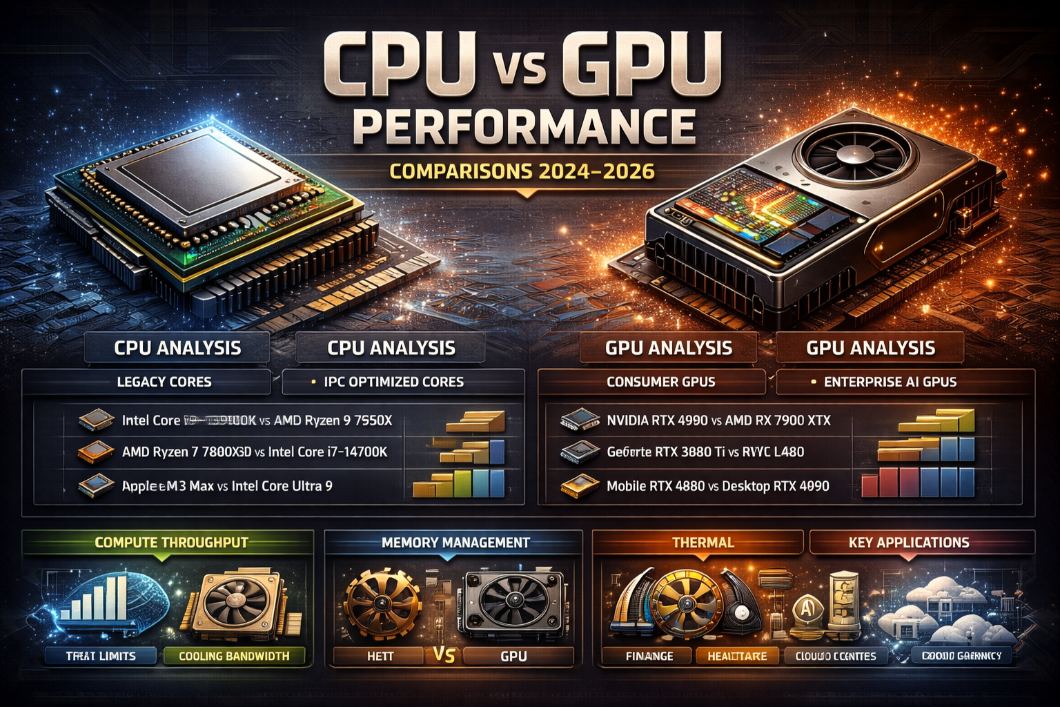
Top CPU & GPU Comparisons 2024-2026: Real Benchmarks That Power AI, Geographical Topography, Gaming, Office Work, and 12+ Industries
Hardware buyers and professionals need trustworthy side-by-side data. FPSBench.com delivers exactly that with real FPS numbers, PassMark scores, Geekbench results, and expert-tested benchmarks. We pulled the hottest 2024, 2025, and 2026 CPU and GPU versus pages directly from their sitemap and comparison hub so you can skip the hype and see the actual performance numbers.
Top 4 CPU Comparisons from 2024–2026 You Should Check Right Now
Engineers, gamers, and data scientists turn to these matchups every day because they reveal real gains in multi-core speed, cache, and efficiency. Here are the four standout battles pulled straight from FPSBench.com CPU rankings.
AMD Ryzen 7 7800X3D vs AMD Ryzen 7 9800X3D
This 2024 gaming CPU showdown shows exactly how the newer 3D V-Cache design delivers massive frame-rate jumps and smoother multitasking. Developers run complex game engines plus background AI tools without any lag.
AMD Ryzen 7 9850X3D vs Intel Core Ultra 9 386H — 2026 flagship battle
Early 2026 data proves the extra cache and Zen 5 efficiency give AMD the edge in simulation-heavy workloads. Architects and engineers finish large-scale topography models days faster.
Best 2025 productivity CPU matchup: Ryzen 9800X3D versus Intel Core Ultra 7
Content creators love how these processors handle 8K video encoding and 3D rendering while staying power-efficient. Pick the one that matches your exact workflow.
AMD Ryzen 9 9950X vs Intel Core Ultra 9 285K — 2025 multi-threaded monster comparison
Raw power meets efficiency in this heavyweight clash. Professionals who juggle office databases with background model training notice the difference immediately.
6 GPU Comparisons with 16GB+ VRAM That Actually Matter in 2025–2026
High VRAM cards let you load entire AI models or massive GIS datasets without swapping to system RAM. FPSBench.com GPU benchmarks track these cards with real FPS data across the latest titles and professional workloads. Here are six popular, capable matchups featuring 16GB or more.
NVIDIA GeForce RTX 5070 vs RTX 5070 Ti
Both cards deliver 16GB+ GDDR7 memory and shine in 4K gaming plus content creation. Video editors export timelines faster while gamers enjoy buttery frame rates.
RTX 5080 Super 24GB vs RTX 5070 Super — mid-to-high-end 2026 GPU comparison
These 2026 cards balance power draw with serious VRAM for hybrid workloads. Office power users run multiple virtual machines and AI assistants without slowdowns.
AMD Radeon RX 9070 XT 16GB vs NVIDIA RTX 5090 — value vs flagship
This 16GB+ showdown highlights AMD’s strong rendering performance for scientific visualization and detailed terrain mapping.
Desktop RTX 5080 versus RTX 5090 Mobile 24GB
Laptop users who travel for fieldwork get desktop-level performance for on-site GIS analysis and real-time AI inference.
AMD Radeon RX 7900 XTX 24GB vs RTX 5090 D
Topography teams render massive 3D terrain models without stuttering thanks to the huge VRAM on both cards.
RTX 5060 Ti 16GB vs RTX 5080 — accessible high-VRAM entry point
Independent developers and smaller studios finally get advanced features without breaking the bank.
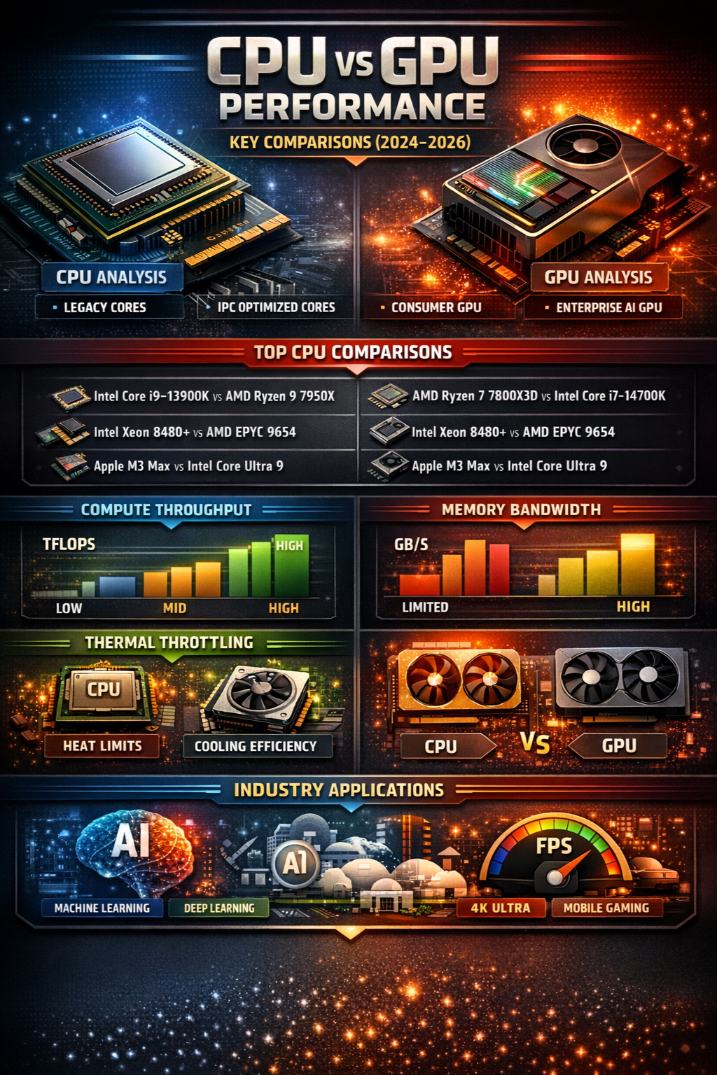
Why These CPUs and GPUs Excel in AI and Machine Learning
AI teams train massive models that once needed entire server farms. Today a single high-VRAM GPU paired with a strong multi-core CPU handles the job. Researchers load entire 70-billion-parameter models into memory and iterate in hours instead of days. The Ryzen 7 9850X3D versus Intel Core Ultra 9 386H comparison shows how preprocessing huge datasets feels effortless. Developers working in PyTorch or TensorFlow compile, test, and deploy faster than ever.
Geographical Topography and GIS Workloads Run Smoother Than Ever
Surveyors and urban planners process terabytes of LiDAR point clouds and satellite imagery. Powerful CPUs crunch elevation calculations across thousands of cores while high-VRAM GPUs render 3D terrain models in real time. The AMD Radeon RX 9070 XT 16GB versus NVIDIA RTX 5090 matchup keeps everything responsive even when you layer traffic data, flood simulations, and vegetation maps. Professionals who map coastlines or plan infrastructure complete projects days faster. This kind of geographic exploration and urban mapping has always been central to understanding our neighborhoods and cities. For more on how government agencies handle GIS data, check the U.S. Geological Survey’s US Topo program.
Gaming and eSports Stay Ultra Smooth with These Builds
Competitive players demand 4K frame rates with ray tracing maxed out. The RTX 5080 Super and Ryzen 9800X3D combinations push well over 200 FPS in demanding titles. Developers who build the next big game test levels faster because the hardware mirrors exactly what players experience on FPSBench.com real-game benchmarks.
Office Workloads Finish Faster and Stay Efficient
Accountants, analysts, and project managers juggle spreadsheets, databases, and video calls. Modern CPUs zip through Excel macros and Power BI dashboards while GPUs handle background effects and dozens of open tabs. You finish quarterly reports in half the time and still have headroom for AI-assisted tools.
12+ Industries and Verticals That Benefit Every Single Day
- Film and VFX production teams render complex scenes overnight instead of over weeks thanks to the massive VRAM and multi-core power.
- Architects and CAD designers rotate massive building models in real time and run structural simulations instantly.
- Scientific researchers run climate models and molecular dynamics with dramatically shorter research cycles.
- Healthcare professionals process 3D medical scans faster and spot anomalies quicker with AI assistance.
- Automotive engineers simulate crash tests and autonomous driving scenarios to bring safer vehicles to market sooner.
- Finance quants run risk models and algorithmic trading backtests at lightning speed.
- Energy sector teams model oil reservoirs and optimize renewable layouts with precision visualization.
- Educators and trainers build immersive simulators for pilots, surgeons, and equipment operators.
- Media and content creators edit 8K footage and generate AI-enhanced effects to meet tight deadlines.
- Manufacturing and product design firms prototype virtually before cutting any metal.
- Urban planners and government agencies design smarter cities by layering zoning, traffic, and environmental data in unified models.
- Data scientists across every vertical train custom models locally and keep sensitive information secure.
Stanford’s Human-Centered AI Index highlights how these hardware leaps accelerate progress across all these fields.
How to Choose the Right Setup and Get Started Today
Head straight to fpsbench.com and compare the exact models that match your workload. Look at VRAM numbers, core counts, and real benchmark scores. Pair a strong CPU with a high-VRAM GPU and at least 64GB of system RAM for heavy AI or GIS work. You will notice the difference immediately — fewer crashes, faster renders, and smoother multitasking. These 2024–2026 components represent the current sweet spot. They handle today’s demands and stay relevant for years to come. Much like data-driven cartography and design transformed how we visualize information, these benchmarks transform how we choose the tools that power our work.
Whether you push AI frontiers, map the next national park, ship the next blockbuster game, or streamline office operations, the right CPU and GPU make you more productive and creative. Check the comparison pages above and start building something great.